
Data-rich, insight-poor: why human judgement drives pharma's AI payoff
Data-rich, insight-poor: why human judgement drives pharma's AI payoff
Pharma is investing heavily in AI-driven CRM and 'next-best-action' tools, but engagement quality hasn’t kept pace. This is a capability gap, not a technology gap. We set out why human judgement is the scarce advantage, and introduce HAISEM: a model for harmonising AI and human capability across the engagement cycle.
The pharmaceutical industry exists to deliver innovative medicines to the patients who need them. Doing this means overcoming structural, clinical and behavioural barriers that slow adoption into healthcare systems and clinical pathways.
Addressing those barriers falls to the teams at the interface of industry and healthcare: Medical, Clinical and Commercial field teams. They are the people meeting stakeholders, navigating complex systems, and translating data into trust.
Building capability to plan and execute these strategies is fundamental to success. As the industry adopts AI tools to drive efficiency, the training models built for a pre-AI world no longer do the job.
The gap between signal, outcome and strategy
Pharma companies are investing heavily in integrated, AI-driven customer relationship management (CRM) platforms from providers like Veeva, IQVIA and Salesforce, building a single intelligence hub for their commercial and medical affairs teams.
The goal is to become more connected and predictive. In practice, the industry is still navigating fragmentation due to the division of tech partners, and regulatory caution over AI compliance.
It is projected that AI-related regulatory violations will drive a 30% rise in legal disputes for tech companies by 2028, and that over-reliance on AI will itself erode the very skills that teams need to use it well.
These risks need to be managed as regulation around data, security, IP and liability tightens. Meanwhile, despite the scale of the spend, the quality of engagement with healthcare professionals (HCPs) hasn't moved at the same pace. Pharma teams now have sophisticated dashboards and 'next-best-action' prompts, but turning those data points into meaningful, value-driven conversations is still hit-and-miss.
Part of the problem lies in a misreading of what AI provides. These systems deliver outputs: probabilities, signals, raw data. They do not deliver decisions. The bottleneck now is human judgement. We have invested intently in deploying AI tools, but under-invested in the human capability to interpret, appraise, and contextualise AI outputs. Until we close that gap, the true ROI of these investments will be out of reach.
Why is the current model not working?
The arrival of AI has coincided with a fundamental transition in pharma engagement: from a product-centric, share-of-voice model towards value-driven, cross-functional engagement with the health system.
In the past, success was often a game of frequency and coverage. Today, success relies on navigating complex stakeholder networks and delivering highly tailored value propositions. AI accelerates this complexity. It creates an environment where Medical, Clinical and Commercial teams are fed a constant stream of "signals": predicted prescribing patterns, patient journey data, and real-world evidence (RWE) insights. At the same time, it gives them tools to work more strategically, such as consolidated reporting, key opinion leader (KOL) mapping, and predictive analytics.
However, the availability of rich data has exposed a critical fissure in field capabilities.
The Commercial challenge: Data without narrative
For Commercial teams, the friction point is the translation of raw intelligence into a compelling value story. An AI algorithm might accurately predict a drop in prescribing volume for a specific territory or flag a new barrier to formulary access. But the algorithm cannot construct the narrative needed to address it.
We are seeing teams struggle to transform these raw, AI-driven insights into the tailored conversations required to convince increasingly sophisticated payers and providers. Without the ability to critically analyse the why behind the data, engagement remains generic, and the "next best action" becomes a tick-box exercise rather than a strategic intervention.
The Medical Affairs and Drug Development challenge: The validation gap
For Medical Affairs and Drug Development, the challenge is one of triangulation and validity. Integrated systems can now aggregate vast amounts of scientific literature and claims data. For example, systems may offer Medical Leads (MLs), Medical Science Liaisons (MSLs), or Clinical Research Associates and Monitors potential insights into adverse events, unmet needs or care gaps. However, these automated insights are often taken at face value.
The “actor network” of modern pharma needs Clinical and Medical teams to be more than data conduits. They have to be capable of "signal listening": testing AI-generated hypotheses against what they are hearing in the field, and validating digital patterns with real-world human feedback, so that AI outputs are stress-tested before they shape strategy. When that validation step is skipped, strategies are built on noise rather than signal. The result is a sophisticated digital ecosystem run by teams who are unsure how to interrogate the data it produces. They are data-rich, but insight-poor.
Why traditional training is not the answer
Faced with skills gaps, the instinct may be to double down on training. However, standard approaches are ill-equipped for this shift.
Most current training initiatives take a utilitarian view of technology. They focus on the functional mechanics: how to use the CRM interface, how to access the dashboard, and how to log the interaction compliantly. While necessary, this is not sufficient. It teaches employees how to operate the machine, but not how to navigate the journey.
Traditional "one-and-done" training (e.g., episodic workshops, static eLearning) fails to drive genuine behavioural change. Ebbinghaus’ seminal work on the "forgetting curve" suggests that up to 50% of learning is lost within 30 minutes if not immediately applied and reinforced. When complex skills like critical appraisal or data interpretation are delivered this way, they rarely translate into lasting habits.
Our research and industry engagement highlight a critical distinction: we are trying to solve a human behavioural challenge with technical solutions. The skills that unlock the value of AI, such as curiosity, critical thinking, and strategic foresight, cannot be installed like a software update. They must be cultivated over time.
Closing the gap requires interventions that change how teams think, not just what they know. We need to move from episodic training events to continuous capability building that is woven into the workflow itself.
Introducing HAISEM
Solving the challenges described requires a new way of thinking about external engagement: one that does not view AI and human capability as separate entities, but as a single, cyclical system.
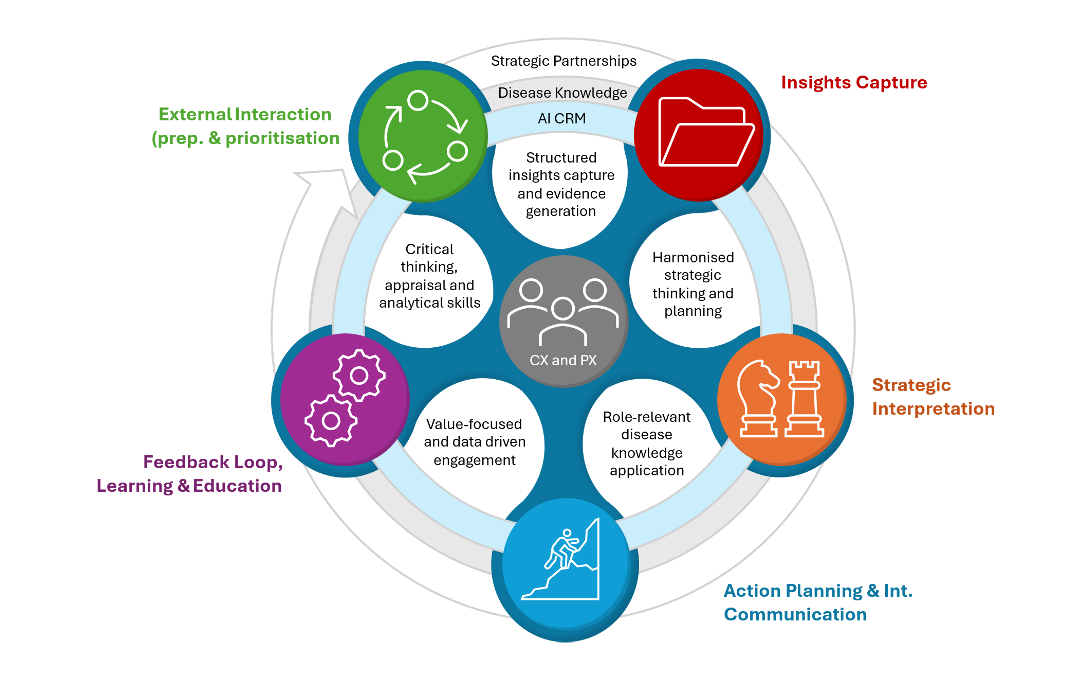
We call this the Harmonised AI-Enhanced Strategic Engagement Model (HAISEM).
Collaborative working exists in most organisations, but it tends to be siloed across teams rather than holistic, and capability development is kept separate from engagement strategy. HAISEM brings these together in a structured model that aligns internal and external engagements, and gives teams a framework to measure impact.
HAISEM is not intended to replace any existing digital tools or training platforms. It is a cognitive framework that helps teams get more from those investments by aligning technology with strategic intent.
HAISEM moves beyond the linear “call and report” model, reframing engagement as a continuous, dynamic loop, where technology and human judgement are mutually reinforcing.
At the heart of this model, AI CRM systems and human critical thinking work together. The technology acts as a catalyst, harmonising data sources and reducing risk. The human professional supplies the appraisal and analytical skills that give the data meaning and turn it into action.
The framework operates across five synchronised stages. We set out how AI-driven CRM supports the activities of each stage:
External interaction (preparation and prioritisation): The cycle begins with strategic planning. AI-enabled CRMs lay the groundwork, supporting shared "next-best-action" (NBA) prompts and predictive lead prioritisation. Treating those AI outputs as strategic inputs rather than automated answers is what ensures the resulting action addresses a genuine unmet need.
Insights capture: This stage moves beyond simple call reporting to structured capture. AI helps Medical, Clinical and Commercial teams document interaction summaries with speech-to-text, while natural language processing (NLP) cleans, tags, and classifies insights. Potential safety signals can be routed automatically to pharmacovigilance teams, and medical insights feed thematic dashboards.
Strategic interpretation: This is the most critical human step, often missing today. It is where data triangulation happens: validating AI-generated patterns against real-world observation. AI can cluster field insights into themes (e.g., barriers to adoption, unmet evidence needs) and surface emerging trends for teams to assess. These insights are then triaged into opportunities, risks, or knowledge gaps.
Action planning and internal communication: Insights are not just stored. They are translated into end-to-end value, from commercial engagement strategies through to research and drug development. Here, AI can support the follow-through: workflow tasks, approvals and campaigns.
Feedback loop, learning and education: Finally, what the teams learn feeds back in two directions. Externally, insights shape more relevant disease and drug education for stakeholders. Internally, they drive the capability building at the core of the model, developing the critical thinking and functional skills Medical, Clinical and Commercial teams need to engage effectively and deliver better outcomes. Personalised, adaptive learning can be assigned automatically, and completions loop back into prioritisation and coaching recommendations for managers.
By placing customer experience (CX) and patient experience (PX) at the centre, flanked by critical thinking and data literacy, this framework ensures that the technology remains a servant to the strategy, rather than the driver.
Delivering the HAISEM solution
Adopting HAISEM requires two things working in tandem, where scientific rigour meets the cognitive science of learning:
Contextual rigour: understanding the nuance of therapeutic areas and the commercial realities of the modern healthcare landscape.
Strategic learning design: moving beyond content delivery to design behavioural change journeys that embed skills like critical appraisal and data storytelling into the daily workflow.
The way forward
The adoption of AI creates a new baseline, but it is not an advantage on its own. AI is levelling the playing field, narrowing the gap between companies with comparable innovation in R&D, capability development and stakeholder engagement. When everyone has the same tools, the tools stop being the differentiator.
What differentiates is human capability. The advantage will not belong to the companies with the most data, but to those with the most capable people interpreting it. The future of field excellence lies in building teams with the critical appraisal, data literacy and scientific acumen to turn AI outputs into sharper strategy, stronger performance and measurable business impact.
References
Gartner. (2025, October 6). Gartner predicts AI regulatory violations will result in a 30% increase in legal disputes for tech companies by 2028 [Press release]. https://www.gartner.com/en/newsroom/press-releases/2025-10-06-gartner-predicts-ai-regulatory-violations-will-result-in-a-30-percent-increase-in-legal-disputes-for-tech-companies-by-2028
Food and Drug Law Institute. (2025, July). Regulating the use of AI in drug development: Legal challenges and compliance strategies. https://www.fdli.org/2025/07/regulating-the-use-of-ai-in-drug-development-legal-challenges-and-compliance-strategies/
Chandrasekaran, A. (n.d.). AI lock-in: Why skill loss puts your workforce at risk. Gartner. https://www.gartner.com/en/articles/ai-lock-in
Murre, J. M. J., & Dros, J. (2015). Replication and analysis of Ebbinghaus’ forgetting curve. PLOS ONE, 10(7), e0120644. https://doi.org/10.1371/journal.pone.0120644
Ebbinghaus, H. (1913). Memory: A contribution to experimental psychology (H. A. Ruger & C. E. Bussenius, Trans.). Teachers College, Columbia University. (Original work published 1885)
About the Authors
Dr Des Conroy is Head of Capability Building at Prova Health, which specialises in strategic partnerships to ensure innovative medicines are successfully integrated into healthcare systems and clinical pathways. We specialise in identifying and addressing real-world barriers to the adoption of new drugs, whether structural, clinical or behavioural.
Dr Meredith Godat is Director and Founder of CogniQuest, which specialises in capability development and learning solution design that will unlock the behavioural and cognitive changes essential to turn strategy into tangible outcomes and measurable impact.